
Sewing instructions for Winona cargo pants
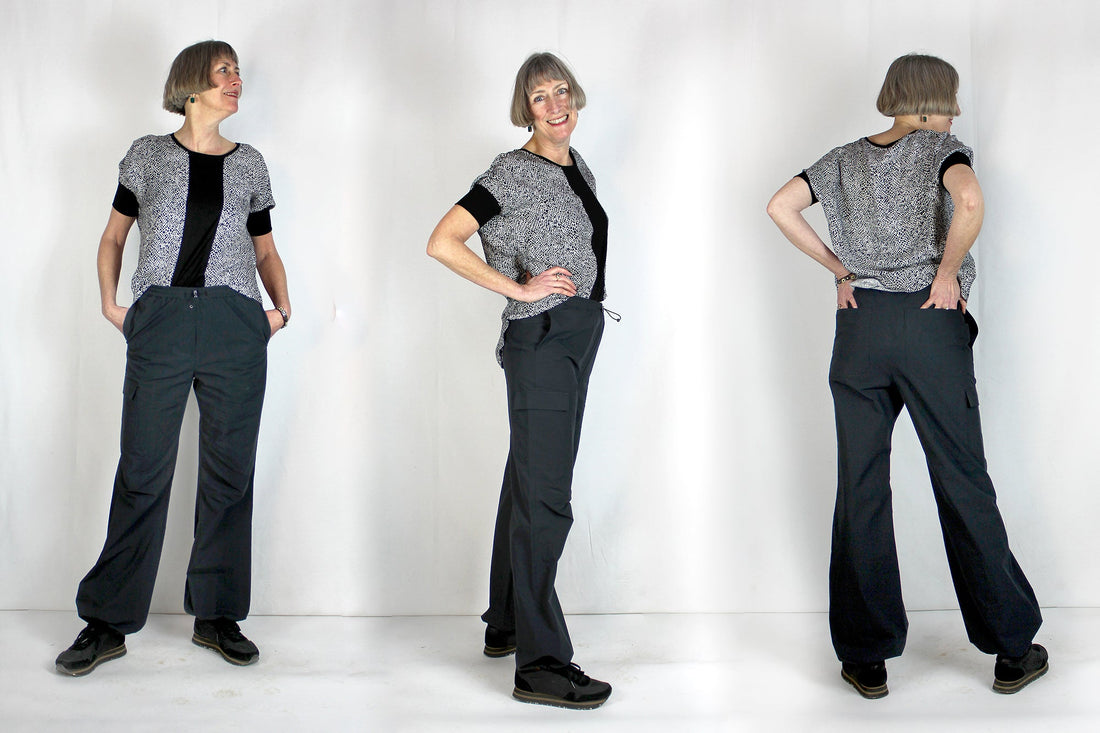
Cargo pants are casual and extremely comfortable to wear. Our new cut features many details: an elasticated waistband with a faux zipper, patch pockets at the front, back, and side, and of course, the knee darts that are essential for the style of cargo pants. You can wear Winona straight at the hem or cinch it with an elastic drawstring; if you do cinch it with an elastic drawstring, you'll need two cord stoppers.
The trousers are 108 cm long, including the waistband.
Winona was sewn from a cotton fabric in this tutorial.
Just so you know in advance:
Materials needed:
We recommend a cotton fabric, which can have some body.
Sizes 34-42
- Outer fabric 2.20 m (140 cm wide)
Sizes 44-50
- Outer fabric 2.50 m (140 cm wide)
Sizes 34-50
- Insert 0.20 m (90 cm wide)
- Rubber 0.70 - 1.10 m (3.5 cm wide)
- Rubber cord 1.80 - 2.10 m (3mm)
- Cord stoppers, 3 pieces
- Stopper bead 1 piece (bundle)
Cut:
Seam allowances are included - 1cm wide or as indicated by the marking notches!
Cut the pattern pieces from your Outer fabric, lining fabric and interlining to. Lay the fabric with the right side of the fabric facing up. All pattern pieces should be laid with the printed side facing up. Always align the thread arrow in the same direction on all pieces, parallel to the selvedge of the fabric. Transfer all notches from the pattern by making a 3mm snip with scissors or by using chalk . Snip the seam allowance on the fold of the fabric, because this is always a center point. is. Markers define positions of Transfer dart ends , pocket positions, etc. either with chalk or pins . For all outer fabric pieces that will be completely covered with interfacing, it's best to first cut them roughly to size. After you've secured the interfacing, cut them out precisely. There is also a video here about gluing and fixing cut pieces.


You will need the following fabric:
- 2x back pants, mirror images
- 2x front trousers, mirror images
- 1x bundle
- 4x pocket bags, 2 of each kind (mirror image)
- 2x back pockets
- 1x side pocket
also with insert:
- 1x flap
- Glue the waistband and hem of the trousers where the buttonholes will be.


Sewing instructions:
Seam allowances are included - 1cm wide or as indicated by the marking notches!
To sew these trousers you will need a sewing machine and an overlock sewing machine, or alternatively the zigzag stitch of your sewing machine to finish the cut edges.
The colored lines in the pictures show you, in addition to the description, where to sew a seam or glue something.
When sewing, pay attention to the seam allowance included in the pattern. Seam allowances not specifically marked are 1 cm wide!
Have fun sewing!
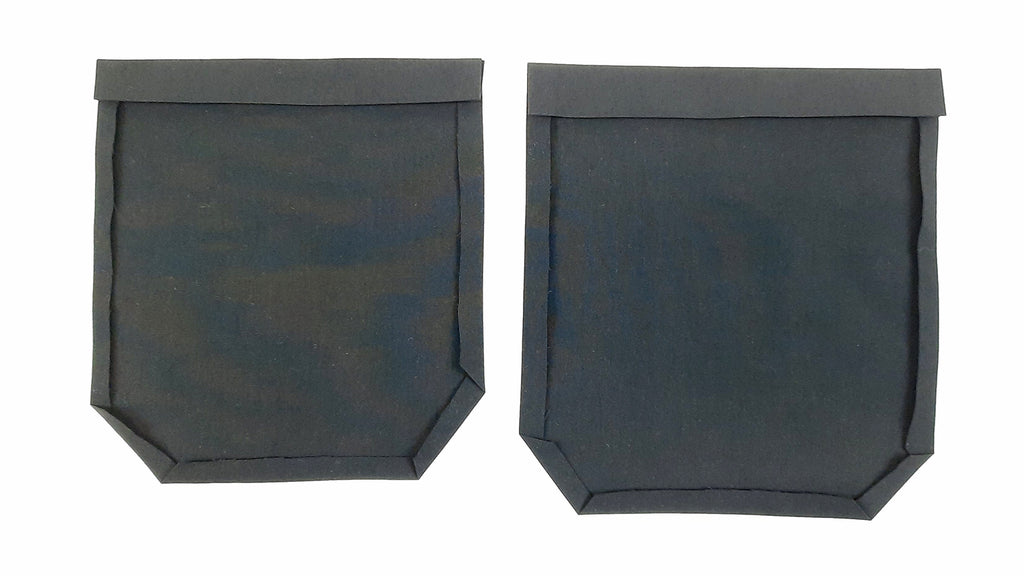
Iron the seam allowances on your pockets over by 1 cm, the top edge of the pocket is folded over twice by 1 cm.

Stitch the pocket opening according to the pattern.

Fold the pocket flap right sides together and sew the sides 1cm wide.

Turn the pocket flap right side out, press the seam allowances, and topstitch the pocket flap along the sides and bottom edge, close to the edge and 0.7 cm from the seam. Topstitch the top edge and finish the raw edge.

Next, the darts in the front of the trousers are sewn down in the knee area.
To do this, fold the dart together, notch to notch, and sew the dart tapering from the side seam to the marking point.

The dart is then folded towards the center and ironed.

Now the dart can also be topstitched close to the edge.

Before proceeding, the trouser legs are finished all around, but the waist seam is not overlocked.

Now the buttonholes can be made in the hem. Please first adhere a piece of interfacing to the area, placing the interfacing on the wrong side of the fabric. Then the hem can be ironed over by 3 cm.

Next, we'll make the side seam pockets. Finish the raw edges of the side seams on the pocket bags. Sew one pocket each to the front and back of the trousers, from notch mark to notch mark. Press the seams.

Place the front of the trousers right sides together with the back of the trousers, so that the side seams are aligned. Fold the pocket bag outwards and sew the side seam. A notch on the pattern indicates the starting and ending points of the pocket opening. Sew the front pocket opening flat.

Now you can close the pocket all the way around and then finish the seam allowances.

Sew the pocket bag to the waist with a basting stitch, 0.7cm, to secure the pocket bag.

Now, place the prepared back and side pockets right sides together onto the markings on the trouser pattern and sew both pockets in place with a narrow seam and a seam allowance equal to the width of a presser foot all the way around. Position the pocket flap right sides together above the side pocket according to the marking and topstitch it 1 cm from the open edge.

Then fold over the pocket flap and topstitch it once close to the edge and then again a presser foot's width away.

Cut a small strip of fabric and sew it into the side seam 6 cm from the hem edge.

Thread the elastic cord through the small loop and then through the stopper. The ends must be the same length.

Now thread both ends of the elastic cord through the buttonholes.

Secure the elastic band to the seam allowance of the inner leg edge.

Now let's move on to the inseams of the trouser legs, which are sewn together right sides facing. Use the notches on the pattern as a guide and stretch the shorter seam allowance to match the longer seam allowance of the front of the trousers. Press these seam allowances open as well.

Now stitch the hem at 2.5 cm, pulling it slightly tight.

Now close the seam at the back, right sides together. To do this, tuck one trouser leg into the other.

Now stitch the decorative seam as a fake zip on the front of your trousers.

Sew the buttonholes at the point marked in the pattern on the waistband, where you have also fixed the fabric with interfacing, and then iron the bottom edge over by 1cm.

Sew the back center seam of the waistband together, leaving a 2 cm gap at the pressed edge. You will insert the elastic band there later.

Now sew the waistband to the trousers, right sides together, so that the back seams are aligned.

Now iron the seam allowance of the waistband into the waistband.

Next, fold the waistband inwards so that the edge just covers the seam and stitch your waistband close to the edge.

Cut a 3.5 cm wide elastic band and push it through the opening in the back center.

Next, sew both ends of the band together with a seam. Double-check that you haven't twisted the elastic band inside the waistband.

Distribute the width evenly and then stitch the waistband twice, creating a tunnel at the buttonhole. Ours is a little misaligned. (sorry)

We used an elastic cord for the waistband again. You can also use regular cord. If you're using cord, first thread the bead through the center and then both ends of the cord through the stopper. After that, you can pull the cord through the buttonholes and into the drawstring casing.

We only pulled the elastic cord up to the side seam and stitched it through the seam there.
Your Winona is finished !
If you get stuck or have any questions, please feel free to contact us by email at info@schnittmuster-berlin.de. We will reply as soon as possible.
Have lots of fun with your new designer piece!
Sincerely, your Schnittmuster-Berlin team.
